Showing posts with label spinning. Show all posts

Thursday, 14 July 2016

2016 Tour de Fleece

So many things to do and places to be and so little time to do it all... :-(

I am currently trying to spin up a storm as part of the 2016 Tour de Fleece.  If you don't know what this is about, check out the SpinFoolish team (http://www.spinfoolish.com/tour-de-fleece/).  I think we are one of the biggest TdF teams with people from all over the world.


Basically the Tour de Fleece runs along the same lines as the Tour de France (the famous cycling race).  We have race days, challenge days and rest days (which are usually spent preparing fibre for the next day).  We don't' compete to spin more than the next person, it is rather about personal challenge and commitment.

This year the Tour de Fleece runs from 2 July to 24 July.  My goal is to spin as much as possible from one of my Border Leicester cross fleeces (left).  This is from Charlie and about 24 micron.

The fleece is unwashed, very clean and not a lot of grease. There is about 3-4 kilos.  In reality, I doubt I will get through it all but hey, that is part of the challenge.


On the challenge days I have started spinning cotton from the bolls.  I picked up a branch like the one on the right from a florist in the city.  They are using them in rustic flower arrangements.

I am lightly carding them into small punis which makes the small staple length easier to spin.

So pop back and visit soon and I will try to post some updates on how much I actually succeeded in spinning.

Happy Spinning :-)

Friday, 18 December 2015

Wool Pickers

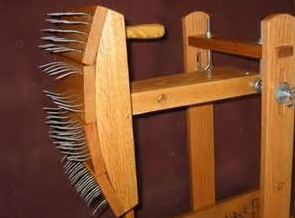
My swing picker (looks much like this one) is my other medieval torture tool.  Seriously just look at those tines!!


There are box pickers and swing pickers.  There are a few manufacturers and also DIY versions on the internet.

With DIY instructions in hand I originally asked a carpenter friend of mine if he would make one for me.  Even he looked wide eyed at all those long stainless steel nails (in the picture) and responded, “you have got to be kidding”.  Well no, I wasn’t kidding, and no, he wasn’t willing to risk injury in his backyard workshop making such a dangerous looking implement. 
So, off to the internet I went again to look for an affordable one.  Eventually I found a lovely lady who was needing to downsize her fibre hoard and fibre implements so a near new one found a new home from her garage to my wool shed.  And I then had a swing picker.
Why did I think I needed a swing picker?
Well firstly it is a bit hard to ‘try before you buy’ many of these tools as they are few and far between.  I hear that many guilds have a selection of tool to try and borrow but as I wasn’t a member of a guild I didn’t have that luxury.  Given I was now processing whole fleeces I thought a wool picker would come in handy.

Do’s and Don’ts of wool picking
  • Do use with sufficient clearance between you and anything else.
  • Sit back from your wool picker (you don’t want your jumper or t-shirt getting picked!)
  • Do understand the ideal set up of your implement.  The spacing of the tines for the type of fleece you are picking is important.  Some implements should always be adjusted with the tines slightly apart, while some are built to interlock the tines slightly as they are offset.
  • Do wash your wool before picking.  Alpaca doesn’t need to be washed first as it has no sticky lanolin.
  • Do sweep it out VERY CAREFULLY and thoroughly after each use. 
  • Don't use out in the open unless it is a breezeless day.  Your fluff will blow away.
  • Don't push your fingers too far into the area where the tines are.  (Hopefully this one doesn't need more explaining!)
  • Don't use near small children or inquisitive pets.
  • Don't overload it.  More is not better and getting too much fibre jammed between the tines makes for a dangerous exercise to sort it out.
What to do with your picked fibre?
  • You can spin from the cloud without further processing.
  • Use this ‘fluff’ to card or even comb into roving.
  • You can dye your fluff but be careful not to agitate it or it will turn into felt.
  • You can use your picker to begin the blending process with different coloured fibres.
The benefits of a wool picker?
  • It quickly gets rid of small amounts of VM.
  • It fluffs up your fibre.
  • It can help you begin to blend large amounts of fibre.

What have I learnt about my picker?
It is one of many tools in my arsenal of fibery things.  I really like to process alpaca fibre through the picker as it is the quickest and easiest way to get the VM out.  Feel free to pop your fibre through more than once. 
Useful links
https://spidersworkshop.wordpress.com/2012/03/23/building-a-wool-picker/

 
Happy Spinning :-)


Monday, 19 October 2015

Hand Cards

Before I launch into today’s blog, I want to thanks all those wonderful people who put in the time to make YouTube videos.  I use them to learn more about spinning techniques, new knitting or crochet stitches, even how to trim the toenails on my sheep.  Whilst sometimes I wish for a less technology based world I would never find enough resources in my local libraries to supplement my search for woolly learning.  Thank you internet and thank you YouTube’rs.  ;-)

I also love promoting other spinners web sites.  One of the first ones of real value that I found (and all you others don’t think your site is no value, I may have just not found you at the time), is Tulasi Zimmer’s site “The Joy of Handspinning” (http://joyofhandspinning.com/).  Tulasi has a wonderful way of explaining things in the most simple terms and with just the right number of pictures to assist.  Her explanation on how to roll rolags was the only one that made sense to me and I finally got the hang of it.  (And Angora rabbits are definitely part of my retirement plan ;-)

Here is a link to her page on hand carding.  Check it out. 

There are many brands and types of hand cards on the market.  I just happen to have Ashford ones but nearly all the wheel manufacturers also make hand cards.  Essentially hand cards are a flat or curved paddle with carding cloth attached.  It is possible to make your own hand cards if you have skills in that area, although I have found it a little challenging to source carding cloth in Australia.


Teachers and experienced spinners may tell you that there are carders for various purposes.  The downside is that when you are starting out you may not be able to buy tools for all occasions and really when you are starting out there is no need to.  (Remember there are no spinning police here.)

You can card most anything on a basic set of hand cards but be flexible with the results if you are trying this with specialties.  Fibres like cotton card better on finer carding cloth, as does angora (rabbit), ox, possum, silk roving, milk silk and various other fine fibres.  That’s not to say it can’t be done, just the results are a little less smooth the further apart the tines on the cloth are.

I only have one set of hand cards and they do everything for me.

My assumptions about hand cards?

I overloaded them at first.  The more you put on the quicker you are going to be able to process this fleece right? WRONG!! You just end up with a matted mess and lots of neps if you load too much on the hand cards.  (Neps are those little balls of fibre.  Sort of like pills in a finished fabric.)

Load just enough to not clearly be able to see the tines.  Most people find it better to use washed wool.  Trying to process unwashed wool will leave your hand cards sticky with lanolin and over time they get grubby so that when you want to process something fine or expensive you need to overhaul your hand cards back to a presentable state (and that may not be easy).  I’m not saying it can’t be done but most spinners will advise against using hand cards for unwashed wool.  Or at least if that is what you want to do, have a second set just for the nice clean fibre.

I also thought that I would get smooth roving from my hand cards.  Well I haven’t yet.  If I start with roving and am blending it, then yes the results are nice, aligned and smooth.  Processing a washed fleece does not get the same results.  Although I haven’t yet tried cutting the tips of the wool off yet.  (yes this is suggested by some!)

Perhaps my results are a little less than what I expected as I didn’t really understand these tools when I first got them.  But I think we all learn best from trial and error.  My hand carding is slowly getting better as I observe more of what I am doing and learn to adjust my technique to observe different results.

But what do I use my hand cards for?

I initially thought I could use them in the house by my wheel in place of the Wild Carder.  Well the results there were yes and no.

Rule 1 of spinning in my house.... ALWAYS have an old sheet or table cloth under your work area.  Even mill washed roving deposits dust and debris under where you are working.  At least with some sort of covering over the floor you can take it outside and give it a shake between having to vacuum after every spinning session.

So I carded to make rolags.  I blended to make coloured rolags.  I used my hand cards to prepare small samples of fibre or colour blends.  I came to the conclusion that my hand cards are a tool with their own purpose.  They don’t replace my carding machine, my flicker brush or hand combs. 

Some spinners appear to do most their processing on hand cards.  But I am looking for variety in technique and from a health and safety view that is also good.  Hand cards are a different action to carding machines, combs and flickers.  And, variety of action is good for us.  

A handy tip... If you ever go to a show to buy fleece, pop your hand cards in your bag.  I find being able to card a few locks of a fleece will give you a better idea of how it will handle when you take it home to spin it.

So where to now?

With spinning being an ancient craft, developed in different ways, and with different fibres around the globe there is much information to be found and much to be learnt.  In this modern technical age we can and should learn much about our chosen craft.  I have included an extra link to the Ashford clip on hand carding, but time and a suitable internet data allowance will allow you to find many many more resources.

I know Wikipedia often gets a bad rap for being unreliable but their page on Carding is pretty informative for those of you who like a little history and technical info, to supplement the practical “how to” type info.  The post covers all sorts of carding and has some informative links at the bottom if you would like to read further.

So experiment and spin happy.

Tuesday, 14 July 2015

Tour de Fleece

I’m sure most of you have heard of the Tour de France.  The cycling race in July each year through towns and mountains and across many countries ending in France.  Well for us fibre focused people there is a Tour de Fleece.  So I teamed up with a bunch of like-minded spinners via the Crazy Sheep Ladies (Spinfoolish

I’m sure there were many other groups to join for TdF fun but hey, my kids call me the Crazy Sheep Lady (when they aren’t calling me the Crazy Cat Lady!!) so you can see what I mean by like-minded!!. ;-)  Different groups have different rules, but just like the comment in my plying post, they are more like 'guidelines'.

As a TdF participant we are asked to,
  • Challenge yourself.
  • Spin.
  • Have fun.

So we are now well underway for our Tour de Fleece.  Among other things, we are asked to challenge ourselves.  Some do a challenge on certain days, others like myself have decided on a challenge for the whole Tour.  I am trying to spindle spin 4oz of MissBabs Hand Dyed.  80% BFL & 20% Tussah silk.  I bought this in the USA while on holidays a couple of years ago. 

It is my first Turkish spindle.  Just a beginner one, not fancy, but I do love it and am really pleased with how fine I have been able to spin on it.  Everyone has a spindle preference (well those who spindle spin do I guess!) and mine is bottom whorl.  The Turkish is just that bit more convenient as you end up with a ball ready to ply.

So a bit more on the TdF.  According to my new friends at Spinfoolish, the Tour de Fleece was started on a blog by Star Athena in 2006 as a way of connecting with other spinners, and by the sounds of it, to incorporate her other passion of cycling.  (Check out Ready to get on your bike for the full story.) The relationship is definitely there.  Just type ‘spinning’ into your favourite search engine and you will get plenty of cycling hits.  You usually need to add ‘wool’ to focus your search on fibre things.

From 4 July to 26 July.  We spin, or try to, everyday except the two rest days just like in the actual tour.

So happy spinning peoples and if you hadn’t heard of the Tour de Fleece before then perhaps you can join us in 2016 for a fun ride ;-)

Now back to that spindle.

Friday, 19 June 2015

To Ply or not to Ply or even How Many to Ply?

So many choices...

Now depending on how you started your spinning journey, who and where you received your advice from, you may get the impression that the spinning police are waiting for you to do something your own way just so they can nab you.  They will make an example of you on what YOU SHOULD NEVER DO and you will forever feel bad about breaking the so called spinning rules.

Well being the closet rebel that I am ......

THERE ARE NO SPINNING POLICE AND YOU CAN BREAK WHATEVER RULE YOU WANT!!!

Now that's out there (yikes!!)

As Captain Barbossa (Pirates of the Caribbean) said about the pirates code, "is more what you'd call "guidelines" than actual rules".  The same applies to many things you are told with spinning.

Not all wool needs to be plied.
Not all singles need to be plied only with another single.

Now I am a creature of habit and usually ply two singles.  I just can't bring myself to knit with un plied yarn.  There is nothing wrong with that, its just not my thing.  But after about 5 years of spinning I finally plied three, yes three singles together.  And, they were different fibres.  Alpaca, Border Leicester and Suffolk X.  (A bit out there, <eye roll> but what the heck.)  I recently found out that most commercial yarn is more than two strands plied together so thought I would try it out.  The result was a fuller yarn.  So far I have Tunisian crocheted mittens and want to wash these a couple of times to see how the combination of fibre types go together before I choose my next creation from them.

When you ply your yarn it creates balance and makes your finished product stronger.  Your knitting is less likely to lean to one side and it often seems to even out any lumps and bumps in your singles.  But plying can be used to create something special and unique.  It may be a colour combination that when knitted ends up looking like a tweed.  You may spin fat singles then ply them with something thinner to create particular effects.  You may ply two wool singles and add a cotton metallic thread for shimmer.  The possibilities are endless.  

I have read multiple times Handspun and Intertwined, both by Lexi Boeger.  If you are wanting hints and tips to do something a bit different with your plying (and spinning generally) try to source these from your local library.  Of course if you find you must add them to your collection the usual online book sellers should have them.

The folks at Spinning Daily have produced a how to guide on Plying.  Check it out at http://www.spinningdaily.com/media/p/8590.aspx  And most of all, be daring and experiment.

So if you wonder why you are told to ply your yarn its because that's how it is usually done.  But remember, it is more what you would call a guideline rather than a rule.

Happy Spinning. :-)

Sunday, 31 May 2015

Spinning raw fleece or washed fleece?

I often hear the question asked, Do you prefer to spin raw fleece or washed fleece?

For some people there may be an easy answer.  You simply may not like the smell or feel of raw sheep's fleece or have no desire to spend time preparing the fibre in any way.  Nicely washed and carded roving is your preferred starting point.

Not all fleece and fibre are the same.  My advice if you are newish to spinning is to keep an open mind and be prepared to try something different from time to time.  And even try something again that you didn't like the first time.

Some fleece, like Merino are high in lanolin (spinners may call this grease) and can be sticky to the touch.  Other fleece such as Border Leicester or Suffolk (I have both) are not so high in lanolin content but some people may find it just as sticky.  I have found that the degree of stickness depends as much on the temperature of your surroundings as it does on the fleece.  I find that the warmer weather melts the lanolin so that it doesn't feel as sticky.  A raw fleece in winter will be a little harder to draft if you are not in a warm room.

Fibre such as Alpaca, Camel, Mohair and Angora (often bunched into a group called hair fibres) do not contain lanolin so many people will spin them after combing, carding or just a good shake.  It is even said by some that it is easier to spin these fibres dirty.  (A word of advice when trying this though, is to place an old sheet under your working area.  I find a lot of dust drops from some fibre and I prefer this not to be on my carpet!!)

So if you prepare raw wools, flicking the tips to get rid of dirt may be sufficient.  The hair fibres often respond well to carding before spinning.

Of course if you choose to wash your wool before spinning you can card or comb without fear of getting your tools sticky from the lanolin.

So, Do I prefer to spin raw fleece or washed fleece?

I don't mind spinning either.  The decision may depend on what I plan on doing with the spun yarn or I may decide to spin a particular fleece a certain way for the experience.

You choose.  But as I said earlier, even if you didn't like it the first time, try it again when you are more experienced.  You may surprise yourself that your view has changed.

Happy Spinning. :-)

Saturday, 2 May 2015

My First Blog

Well I'm not there yet and I think it will take me longer than I would like to get this blog underway.  However, for those who might visit during my development phase you probably want to know what this blog will be about.

I am a shepherd and a hand spinner.  This blog is to share my spinning journey with anyone who want to know.  But also to share some of my learning and experience along the way.  I'm largely self taught but have had a few lessons.  I can't share with you now as it will spoil the topic of a future blog.

If you have an interest in hand spinning, this might be a place for you to check out from time to time.  I would also like it to be a source of information for Australian spinners as Aussie info is sometimes hard to come by.

I'm not sure when my next post will be as I am still learning how to set up my site just the way I want it.  Hopefully I will see you in the very near future.

Happy Spinning.
Suellen